Chapter 3 Early Strut Spheres
The sphere has always been admired for its potential material
economy. The strength of a thin shell as demonstrated by an eggshell,
results from its structural continuity and axial loading. The
problem with the sphere is the complexity and irregularity of
the connector. The geodesic sphere with a surface divided by
a regular pattern of straight lines has been used to counteract
this. Fuller and those who have followed him have generally organized
these lines to take advantage of the repeatability of the triangularized
surface of one of the regular platonic polyhedra; the icosahedron.
It has the largest number of identical equilateral triangles
where the vertices all fall
on what would be the surface of a sphere. Each of these triangles
can then be further subdivided into smaller triangles, the key
to part repeatability.
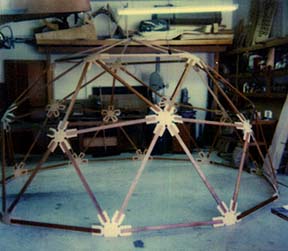
The photo depicts Spheroid #5 a 2V spheroid where each icosahedral edge has been divided in two. First constructed in 1979 it is 15' in diameter and the two types of brackets are 5/32" thick birch plywood which bend such that they fit into notches in the ends of the struts and on the inside surface of the struts a few inches in from the end of the struts. The the two types of struts are 1x2's. This structure led to experiments in which I tried to thicken the node bracket by moving the node center outwardly during which I found that when the bracket got thicker I could actually place its perimeter on the outside surface of the struts rather than the inside and reduce the bending required from the assembly.