|
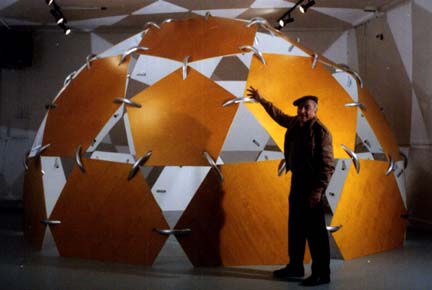
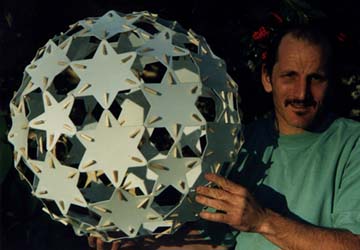
Chapter 6 More Panel Spheres Here are two more images of these icosa ball structures. This is my dad in front of a 17' diameter version also circa
1991. These models are describable as surface consolidations
of a 4V icosahedron.
|
This one was "celestial" ball where the hex and
pents are turned into the star shapes. This checkerboarding of
the sphere surface, has resulted in Janice Avery wrote: I am enjoying the sessions - I find that I anxiously go
to hotmail to check jan |
|
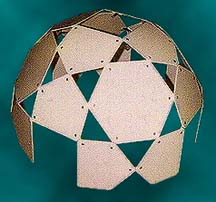
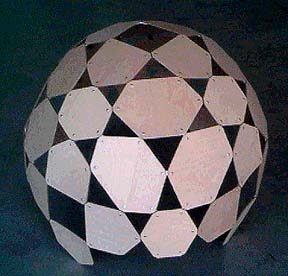
Chapter 7 I am glad you are so interested. I also am enjoying putting this stuff together. I have photos of here models made similarly to the last pinned spheroids except that both have been fastened with pop riveted aluminum bent straps. Both are also variations of an octahedral based sphere instead of an icosahedral one. Note the square opening where the orthogonal axis pass through the sphere surface. The first smaller model (below) is a surface consolidation of a 6V sphere, the second of an 8V.
|
![]() There are three modified hex panel forms in this model where there is only one in the smaller model in the center of each base triangle area. Also there is as additional hexagonal panel in between each of the two five sided panels along the base triangle edges. This larger model was the last of this type. We will move back again to variations of the rhombicube form in this quest for simplicity. |
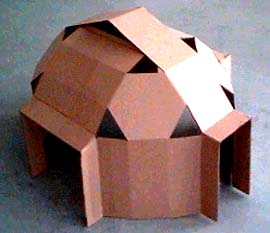
| Chapter 8 We are now in 1995. Taking that basic rhombicube and modifying it another way is shown below. This first model I called a barnlet. Notice that what would have been a triangular open space now has a hexagonal panel in it. And what were the square panels have become a group of three rectangular panels that arc outwardly with the hex panels attached to the center segment. Also note that all of the panels on one longitudinal axis (from front right to rear left) have shrunk in width. This photo is of a small model. I did make one approx. 6' x 9' also out of cardboard. ![]() |
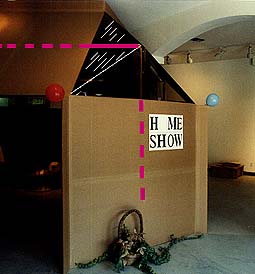
A portion (above) of the next larger structure shows that the walls have gone back to being flat but a structural frame has been added. I have highlighted the frame because it is both behind the cardboard and the plastic windows that are in what were the triangular open spaces (the upper left window is also lightly hatched). Note that the geometry of the frame follows the edges of a cube. This model has 6' square wall panels and was 14' across. With 8' square panels it would have been 18'. The frame around the square openings provided the panel connections and was planned to link the module to adjacent modules. NEXT |